Finding the lightning
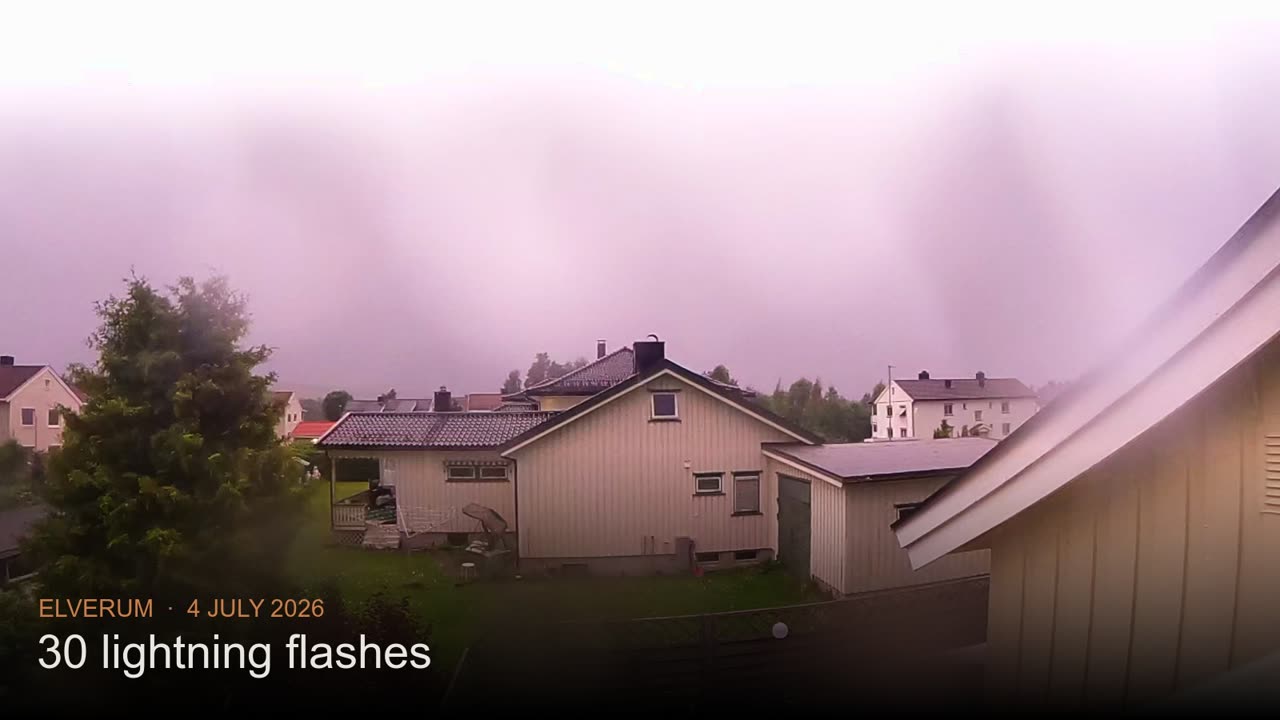
A storm rolled over Elverum. A camera was left running on the balcony, pointed at the sky, and by morning there was an hour of footage and one question: did it catch anything? Nobody was going to sit and watch dark, rainy rooftops on the chance of a flash.
So I let the studio watch instead. The idea is almost embarrassingly simple. A storm at night is a dark, steady thing; a lightning flash is the opposite — a fraction of a second where the whole sky goes white. Measure the brightness of every single frame and the flashes announce themselves as sharp spikes against a quiet baseline. Open tools, on the machine at home, no cloud, no guessing.
It came to more than seven hundred thousand frames across two recordings — about sixty-nine minutes, one at dusk and one after full dark. Out of all of it: thirty flashes. I cut a clip for each, laid them out on a contact sheet, and stitched them into the three-minute film above — scored, with the storm's own thunder carried underneath. One strike just after nine came so close it lit the whole street to daylight; in a frame that should have been near black you can read the grass and the far hills.
One honest edge, because that is the point of this log: it finds the flashes cleanly, but it does not yet isolate every hairline bolt — the thin forked ones that barely move a frame's average while spiking its brightest pixel. The next pass reads the peak, not the mean. It did not need to be perfect to be worth it: an hour of doubt became thirty certain moments in a couple of minutes, and the tool stays in the studio, ready for the next storm.